
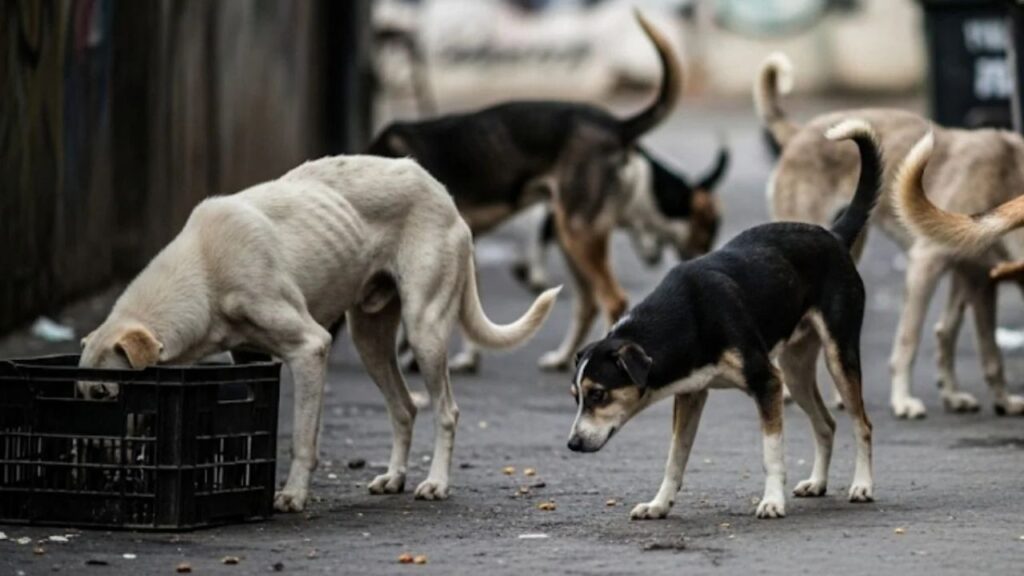
The Supreme Court’s hard-line push to clear Delhi-NCR’s streets of stray dogs moved into a decisive pause on Thursday as a three-judge Bench reserved orders on pleas challenging the directive, even as it refused to freeze implementation. The August 11 order requires authorities to start “at the earliest” picking up stray dogs from “all localities, more particularly the vulnerable localities of the city, as well as areas on the outskirts,” and to confine them in shelters within six to eight weeks.
It leaves no ambiguity about enforcement or endpoints: “There should not be any lethargy or compromise in undertaking this exercise,” and “not a single stray dog picked up from any part of locality should be released” to public spaces again.
The Bench made it explicit that the initiative was anchored in public safety and not sentiment, recording that “Infants and young children, not at any cost, should fall prey to rabies. The action should inspire confidence that they can move freely on roads without fear of being bitten by stray dogs. No sentiments should be involved.”
Issued by Justices J.B. Pardiwala and R. Mahadevan on August 11, the directions bind the Government of NCT of Delhi, the Municipal Corporation of Delhi and the New Delhi Municipal Council to create dog shelters and report on city-wide infrastructure within eight weeks, beginning with capacity for about 5,000 dogs in six to eight weeks and scaling up thereafter.
The order mandates sufficient personnel and facilities for sterilised and immunised dogs and for those detained from public spaces, continuous CCTV monitoring “to ensure no dogs are released or taken out,” and meticulous record-keeping. A helpline must be operational within one week so that all dog-bite cases are reported and “action should be taken to round up, catch the dog within 4 hours after a complaint is received,” with the victim directed to immediate medical care.
The court also flagged vaccine supply as a governance priority, directing authorities to publish “detailed information of vaccines available, the stock of vaccines and the persons who have sought it.”
Territorially, the net is wide. Besides Delhi, the order extends to Noida, Ghaziabad and Gurugram. Local bodies are to maintain a daily log of captures and shelter intake and produce the records on the next date of hearing. The judges warned that any person or organisation obstructing the process will face “stern action” and that “any hindrance or objections… in the smooth and effective implementation of our directions, will be viewed as contempt of the Court and we will proceed in accordance with law.”
During the proceedings, Justice Pardiwala questioned the ABC practice of returning sterilised dogs to their original localities, calling it “absolutely absurd and doesn’t make any sense at all,” and distilled the immediate task into an unambiguous call to action: “Whether sterilised or not sterilised, society should be free from stray dogs. You should not find a single stray dog moving around in any locality of the city or in the outskirts… Start picking up all stray dogs at the earliest in all possible manner and shift them at a far off place.”
Suggestions to put captured dogs up for adoption were rejected with the Bench remarking that “stray dogs should not become pet dogs overnight.” The court also made clear that it would not entertain interventions from individuals or organisations in this matter “in the larger public interest,” reiterating that “no sentiments in this type of litigation should be involved.”
The suo motu intervention, the judges recorded, stems from an urgent need to arrest dog-bite incidents and prevent rabies deaths, with the first compliance reports due as the shelter network and helpline come online.
On August 14, as multiple petitioners sought a stay, a Bench of Justices Vikram Nath, Sandeep Mehta and N.V. Anjaria declined to halt the August 11 directions and reserved orders after an extended hearing. The Bench publicly rebuked civic bodies for their absence and inertia, “Local authorities are not doing what they should be doing. They should be here taking responsibility”, underscoring that accountability for implementation sits squarely with the municipalities and the Delhi government.
Senior advocates Kapil Sibal, A.M. Singhvi and Sidharth Luthra argued that the order “puts the cart before the horse,” pressed for compliance with the Animal Birth Control Rules, 2023, and flagged the absence of stakeholder consultation, including from NGOs working in the field. Solicitor General Tushar Mehta opposed any pause, placing on record the scale of dog bites and rabies fatalities and emphasising that children form a large share of victims, framing the August 11 directions as an urgent public health intervention.
The August 11 order is as much a logistical blueprint as it is a legal command. It contemplates a progressive expansion of shelter capacity beyond the initial 5,000, continuous CCTV oversight of shelters to prevent releases, a four-hour capture response standard triggered by the helpline, mandatory sterilisation and immunisation “as required by Rules,” and a categorical bar on returning dogs to streets “under any circumstances.”
The court’s monitoring architecture compels daily capture logs, vaccine stock disclosures and prompt medical coordination for bite victims, with non-compliance risking contempt. By explicitly authorising authorities to “create a force” to carry out the exercise “at the earliest,” and by warning that reported violations will invite “stern action,” the order puts the onus on local governments to demonstrate speed, scale and discipline.
As of today, the legal and civic timelines run in parallel. The Division Bench that issued the suo motu directions has fixed the matter for further monitoring with reports due, and the three-judge Bench has reserved its order on the stay pleas, leaving the original directions in place. The effect on the ground is immediate: a city-wide removal of stray dogs from localities, the setting up of shelters with surveillance and veterinary capacity, the creation of a dedicated bite-response helpline, and a public accounting of vaccine availability.
For a metropolis used to the ABC-and-release model, the Supreme Court’s insistence that “not a single stray dog” be returned to public spaces marks a stark legal pivot aimed at eliminating fear from everyday mobility, especially for children. Whether these measures remain intact, are refined, or are judicially recalibrated will turn on the reserved order, but the court’s message, for now, is stern: it is “time to act,” with public safety as the lodestar and compliance the test.